

 0 Comments
On January 29, the Lenfest Center of the Arts hosted an interdisciplinary panel discussion focusing on the scientific, artistic, and cultural aspects of trees.
A minor concern I had about moving to New York for college was that I would miss the nature of my hometown. Not that I had lived in a very rural area beforehand but I had this idea of New York City as a cutthroat concrete jungle. I should’ve known better—with Riverside Park just around the corner—but there was still this feeling that the city would eventually swallow me whole.
Over the course of my first semester, the topic of trees was brought up again and again in my science classes (which I enjoyed! Being able to participate in the 2025 Tree Count census was very fun). So when I heard about an event titled “Being Treely” just weeks into my second semester, I was curious enough to look into it.
“Being Treely” was a panel discussion consisting of scholars from the fields of science, philosophy, art, and literature, whose research centers on trees. What interested me most about this event in its online description was its focus on “rethinking our relationship to trees and plants and their intersection with temporality, history, physical space, and materiality.” As someone who was initially worried that the city would distance me from nature, I was drawn to this event that wanted to reevaluate the idea of trees as being separate from the city. I was enthusiastic to hear from scholars at Columbia about how nature continues to shape our experiences, even here in New York.
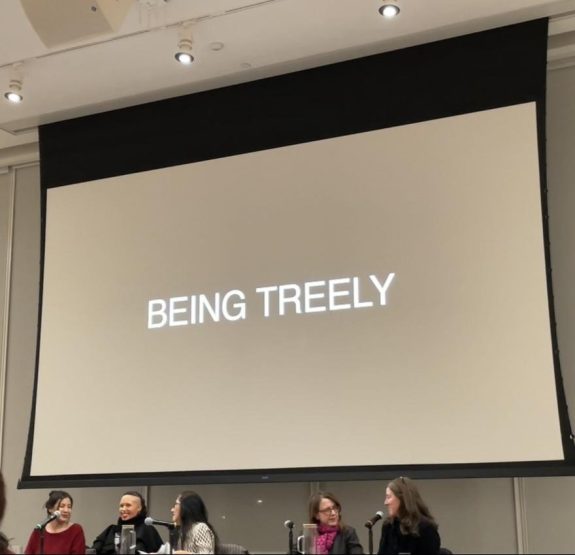
Panelist speakers, from left: Darylina Powderface, Rachel Grace Newman, Miya Masaoka, Patricia Dailey, and Nicole Davi
English and Comparative Literature professor Patricia Dailey opened the discussion by stating that trees “provide legibility for our being in the world in both positive and negative ways,” referencing both their figurative use in representing lineage and their scientific significance in climate change research. She then discussed a seminar in Columbia she teaches—which is aptly named Trees. In this seminar, students examine trees in relation to language, history, religion, colonization, and decolonization. This course culminates in the exhibition “Thinking Treely,” which explores representations of trees across cultures through documents and artwork ranging from medieval Japan to nineteenth-century America. Dailey is currently working on a book that traces how the word “nature” entered the English language.
Rachel Grace Newman, a professor of African American and African Diaspora Studies, focused on Silk Cotton trees and their cultural significance in the Caribbean. She began by introducing the story of Imogene “Queenie” Kennedy, who in her childhood had spent 21 days inside a cotton tree where she was taught rituals and customs by ancestral spirits. She would draw upon these experiences as a leader in the Kumina practice. To explain Kennedy’s experience to us, Newman elaborated on how cotton trees were considered sacred by both the Indigenous Taíno people and the enslaved Africans who were forcibly brought to the region by the Atlantic slave trade. Newman gave examples as to how they are revered: they are never cut without proper offerings, their trunk and roots are believed to be crossroads through space and time, and the tree “bears souls suspended through eternity”. Because the trees predate the arrival of Columbus, they retain what Newman described as “knowledge of what was before.” They preserve cultural memory that existed before and has survived colonial violence.
Visual artist Darylina Powderface brought a valuable Indigenous perspective, opening with a photograph of Blackfoot Native Americans on top of a hotel in Herald Square. Rather than staying in the suites inside, they set up traditional tipis on the rooftop for the duration of their stay. Quoting Linda Tuhiwai Smith, an author of Māori Indigenous identity, Powderface said “through this form of introduction you locate yourself in a set of identities which have been framed geographically, politically and genealogically.” Powderface went on to talk about her own heritage, introducing the Blackfoot term kipaitapiiyssinooni, meaning “our way of life.” She presented a visual representation of a kinship cycle in the form of a circle with enclosing rings: elders and children occupy the center, while women and men are positioned along the outer rings. A kinship cycle generally illustrates social relationships within the community, with this specific cycle emphasizing elders and children as central due to their role in holding and passing on knowledge, while those on the outer rings are responsible for the protection of the community.
Working from this framework, Powerface questioned how we could “reimagine a world of relationality” when colonialism and imperialism are at the forefront of our present. She concluded by sharing a creation story in which humans did not initially exist but came into being when the Earth fell in love with the moon. With no guidance on how to live, the first humans learned by observing and listening to the natural world around them.
Next, Nicole Davi, a senior researcher at the Tree-Ring Laboratory, posed the question “What are trees telling us?” Drawing from her position as a professor and chair of environmental science at William Paterson University and a researcher at the Tree Ring Lab at Columbia’s Lamont-Doherty Earth Observatory, she discussed the focus of her work on developing climate records. Her research relies on dendrochronology, a method that uses tree rings to reconstruct past climate patterns. While meteorological stations are more commonly used to understand climate from the past, Davi noted that the oldest of these records date only to the nineteenth century, offering “just a snapshot” of Earth’s climate history. In contrast, characteristics of tree rings—such as width, chemical composition, and physical damage—provide fixed and measurable data that can extend much further into the past. When compared with existing meteorological data, tree-ring records of the same corresponding times align closely.
Davi highlighted her most recent studies, which focus on reconstructing hurricane histories with maritime forests of the Northeast. She pointed out that these ecosystems are notably vulnerable due to encroaching seawater and human activity. Protecting these ecosystems, she argued, would not only allow for continued climate research but also provide benefits to humans, such as buffering wind and supporting groundwater systems.
Concluding the panel, Miya Masoaka, Chair of the MFA Visual Arts and Sound Art Program, reminded us that we “are more tree-like than we think” and that “our breath is a shared breath” with them. She described this relationship as “humfolia,” a combination of the words human and foliage. Referencing the book Through Vegetal Being by Luce Irigaray and Michael Marder—which explores the significance of plants to human existence—Masaoka discussed how plants offer an alternative to our materialistic culture. She then posed the question, “What does it mean to go to a concert if there is no sound?” Trees emit sound, frequencies far above 20kHz, but humans cannot hear them. Masaoka suggested that the silence itself allows humans to step away from urban noise and enter what she calls “a shared timespace with trees.” To explore this idea, she composed Singing Treely, a musical composition created from recordings of trees and intended to be performed for them, in their own language. Her work culminated in a public performance where audience members could sit as they would at a traditional concert, but the music playing was silent. Nothing was heard apart from the naturally occurring sounds around the audience.
According to Masaoka, across literature, history, science, and art, trees emerged as a sort of archive. For Dailey and Newman, trees make history legible, whether expressed through language or culture. For Davi, they preserve environmental records through climatic data. Powderface and Masaoka also add to this framework through relationality, positioning trees not as objects to be studied but as co-participants in the world alongside humans.
Trees are not separate from human life, nor are they passive parts of the landscape. They are intertwined deeply in how we understand history, space, and ourselves. In New York City, which is often perceived as conflicting with nature, “Being Treely” offered me a reminder that nature is not something left behind but something growing alongside us.
Image via Author

 Loading ...