

 2 Comments
Late last semester, Bwog Science went on campus to flag people down and find out how they understand science and its role in society.
Bwog Science has been curious… What does science actually mean? In an institution well-known for its scientific research, as students, we are rarely asked to consider the meaning of science, both at Columbia and beyond. Late last semester, we walked around campus armed with a gigantic sign that read, “What does science mean to you?” We wanted to get outside and hear from the Columbia community about their opinions and relationships to science.
We started off outside Barnard Hall, catching a few answers from students rushing by.
First, we ran into Eira (BC ’28), a fellow Bwogger and political science major. Although she voiced concern that her answer was “going to sound stupid”, she responded, “Science is observing the world around you and then coming up with an answer that can prove things about not only life, but human nature.” Eira’s thoughts were meaningful, but her hesitancy to answer highlighted the difficulty many humanities students face in discussing science, even though it often intersects our studies and has direct implications for all of our lives. Her insightful answer touched on a major element of what doing science actually is: observation and theorizing.
Next, we talked to Ana (BC ’26), a physics major, who stopped to chat before running to class. Ana emphatically provided, “Science has roots in Western philosophy, and I think it’s more of a philosophy and an institution than it is just knowledge building.” She challenged the often limited scope of science in university settings, adding that there are “lots of different ways that you can find out knowledge about the world we live in, not just through the scientific method. Curiosity is not just in the lab pipetting.” We found this answer fascinating as it challenges the straightforward nature of what many presume science to be. Considering science to be a philosophy is not only historically grounded, but allows one to understand science as an undertaking that not only can evolve, but leads to entire paradigm shifts in terms of the bounds of what we know and how we know it (as science theorist Thomas Kuhn would say).
As the afternoon rush of Barnard students began to slow, we decided to move our operation across the street. Outside Butler Library, we were excited to get answers from the variety of students and staff passing by. The insights we received ranged greatly from science as a way of understanding the world to science as something deeply personal.
Starting off strong, Adam (CC ’28), a chemistry and math double major, declared, “Science is a way to understand reality without all the doubt.” We appreciated Adam’s confidence and agreed with the sentiment that science serves to find empirical answers to life’s most important and complicated questions. Although it is essential to consider scientific findings within their broader context, and “truth” can always be debated, science provides humanity with the best tools to begin understanding our reality.
In a related vein, Ethan (CC ’28), a math major, talked lovingly about how science has impacted his life. He expressed, “Science is able to help me branch out my imagination and see what is possible. It creates questions about the world that I didn’t know I had, and it makes me incredibly curious about what could be next for us as humans.” Bwog Science was grateful to hear from students like Ethan, who are fascinated by solving the mysteries of the universe with science.
Our next participant, Arjun (CC ’29), is a biology student who answered passionately, “Science is all about the exploration of the natural world and our surroundings…There are many ways to interpret the natural world.” Bwog Science appreciated how Arjun’s answer touched on the diversity of perspectives on research in the scientific field. Ideas must continue to be deconstructed and debated; there is no one conclusive answer. Science is not only about what happens in the lab, but how those findings are interpreted to comprehend our surroundings.
Walking down College Walk, we ran into Audrey (CC ᾽29), a political science major, who discussed the origins of the word science. She noted, “The word science comes from the Latin term scientia, which means to know. So, I think science is very broad in the sense that it’s anything that you can study systematically and come to know. Audrey also mentioned the worrying situation of science today, “Science is obviously important because there’s a lot of anti-intellectualism going around lately. Lots of funding is getting cut. This is something I worry about because I want to do research one day. ” We found her answer interesting, and especially important when considering federal funding cuts at Columbia and other institutions under the Trump administration.
Demonstrating the importance of curiosity, Scott Donie, Columbia’s head diving coach and two-time Olympian, discussed quantum physics: “My daughter is a physics major at Barnard, and I want to learn more about physics so I can talk to her about it.” Mr. Donie’s answer warmly demonstrated how an intrinsic curiosity regarding science can help us connect and further our understanding together.
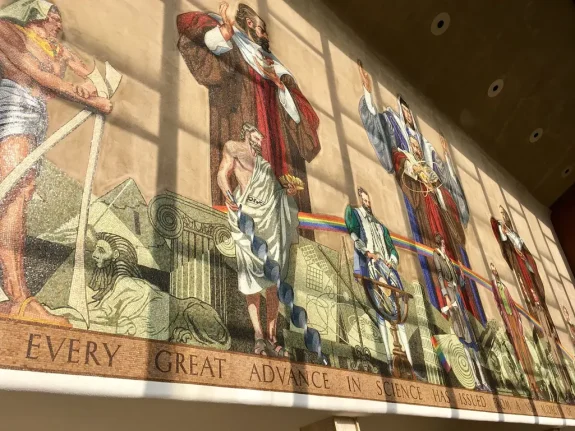
Finally, Kenneth L. Thompson Jr., a poet who found us outside Butler, discussed his experience going to the Bronx High School of Science many decades ago. Mr. Thompson told us, “I went to Bronx High School of Science, and there is a mural there that reads, “Every great advance in science has issued from a new audacity of innovation.” We need scientists who have this audacity and imagination. That’s what science means to me.”
By talking to the Columbia community, we learned about the ways science impacts and influences people’s lives. Science is not an abstract discipline. Rather, it is a philosophy, a means of connection, and a way to understand the world around us. Science doesn’t exist solely in classrooms and laboratories. Science is living with us, changing every day.
It is that grand and humanistic audacity, an idea that has stuck with Mr. Thompson for so many decades, which pushes our understanding forward and crafts brave new ideas. Understanding the place of science within our society, and how people interpret its purpose, helps defend its lasting value, one that should continue to be celebrated at Columbia and beyond.
If you have any additional thoughts about science at Columbia, reach out to science@bwog.com.
Image via Bronx Science Alumni Foundation

 Loading ...
2 Comments
@Robot Woah?!
@Anonymous Woah!!