

 0 Comments
The new exhibition at MoMA (~ 8.22.2026) explores the world of Marcel Duchamp, the consummate iconoclast of 20th-century modern art.
(All key facts about the artist’s life and works are based on curatorial notes at the exhibition site and the exhibition website.)
For those who are unfamiliar with Duchamp, here’s a picture of his most famous work:
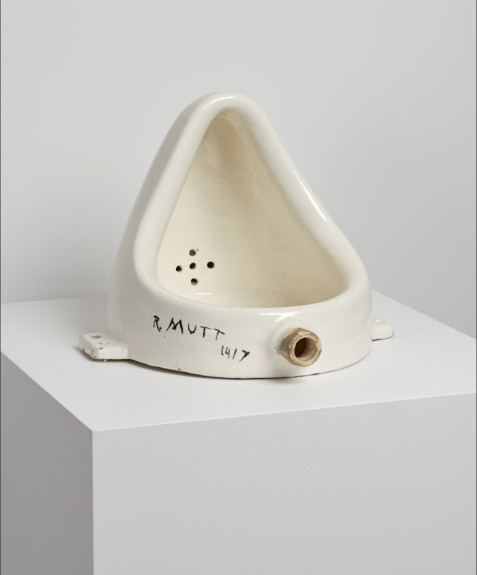
“Why is this art?”
It is a question Duchamp’s work has provoked for over a century, and one that still hangs in the air of every gallery he inhabits. More than any other artist of his time, he turned away from what art had always been, and kept asking what it could still become in a world that kept becoming entirely new. That question, stubbornly unresolved, is what keeps his work alive.
It is completely normal to laugh at his work. A bicycle wheel on a kitchen stool. A shovel hanging from the ceiling. A urinal with someone else’s name on it. Viewers of Duchamp’s work constantly write it off as something anyone could make, as art without any real thought behind it. The new MoMA exhibition, the first retrospective of his work in the United States since 1973, is an argument against all of that. What this carefully, lovingly, rigorously assembled show reveals is an artistic mind that extends far, far beyond a urinal. Moving through his lifetime in chronological order, from his earliest paintings to the work he was making weeks before his death, it traces an artist whose fields of inquiry crossed painting, drawing, sculpture, printmaking, photography, film, graphic design, and exhibition design. But most of all, he is the one who remained, across all of it, unmistakably himself.
Brushstrokes of Motion
The first gallery surprises you. Knowing Duchamp mostly by the reputation of his urinal, you walk in expecting strange objects and baffling gestures. Instead, you find yourself surrounded by dozens of framed paintings hanging neatly on the wall, looking not entirely unlike art you have seen before.
Duchamp grew up inside art. His grandfather was a printmaker and painter, his two older brothers were practicing artists, and by his own description, he was “naturally in an aesthetic bath all the time.” After moving to Paris as a young man, he fell into the orbit of avant-garde painters like Cézanne and Matisse, absorbing their rejection of academic convention. In these early years—his “swimming lessons,” as he called them—he moved through oil paintings and satirical cartoons.
What is striking, walking through this first gallery, is watching him change in real time. The early works are assertive and vivid, their colors strong and primary, projecting the people and scenes of his daily life with an almost aggressive confidence. But slowly, painting by painting, something shifts. The figures lose their edges. The colors break apart and reassemble. The forms grow angular, fragmented, and Cubist, like the paintings of Picasso.
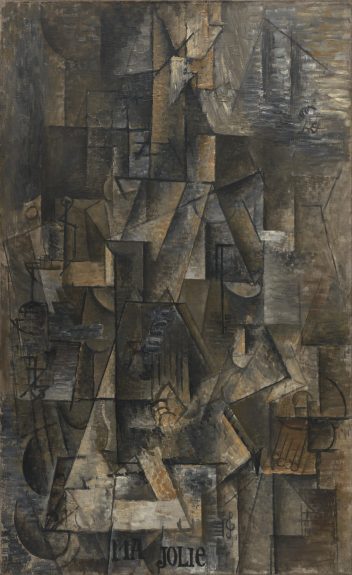
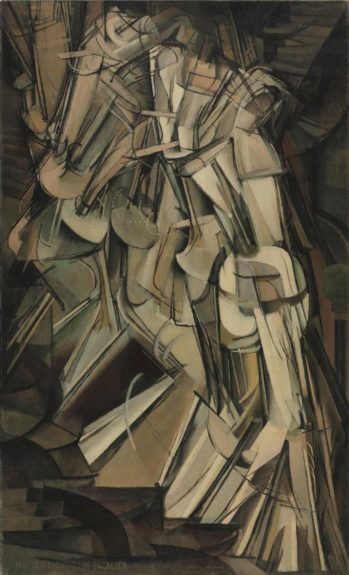
(Left) Pablo Picasso, “Ma Jolie”, Paris, winter 1911-12. (Right) Marcel Duchamp, Nude Descending a Staircase (No. 2), 1912. Museum of Modern Art, New York, https://www.moma.org/
The sharpest expression of this transformation is Nude Descending a Staircase (No. 2) (1912). The figure has dissolved entirely into a cascade of overlapping geometric planes that seems to be in motion but nothing is clearly recognizable. Now treated with quiet reverence by MoMA and critics around the world, it was originally considered so strange and unsettling that Duchamp’s own brothers came to his studio to suggest he change the title before submitting it to an exhibition. He withdrew the painting instead.
The gallery plays fragmented piano music through the speakers while you stand in front of the piece. The notes feel disconnected, the rhythm slightly off, dissonant in a way that is hard to name. It makes the painting stranger and more right at the same time.
The Alter Ego
If you move quickly through the next section and skip the wall labels, you might stop short at an unfamiliar name appearing on several artworks: Rrose Sélavy. Who is she?
Unknown facts about the artist emerge and unsettle, expanding our knowledge of Duchamp’s world into an entirely unexpected realm. Rrose Sélavy is an alter ego Duchamp created in 1920, deciding that “it didn’t suffice [for] me to be a lone individual with a masculine name. I wanted to make another personality for myself.” The two pieces in this section, attached below, were the most striking representation of this extraordinary and bold female figure, helping us understand her on her own terms. Wearing a whole new set of rules, Duchamp’s work took its course as something rule-breaking and entirely its own. It was difficult to distinguish Duchamp’s work from Sélavy’s, but this disorienting overlap makes one pay close attention to the curatorial cards of each work to figure out which one made it.
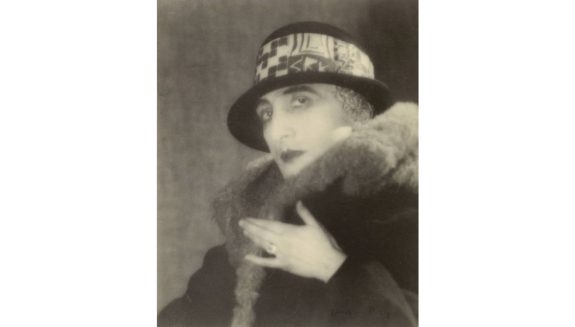
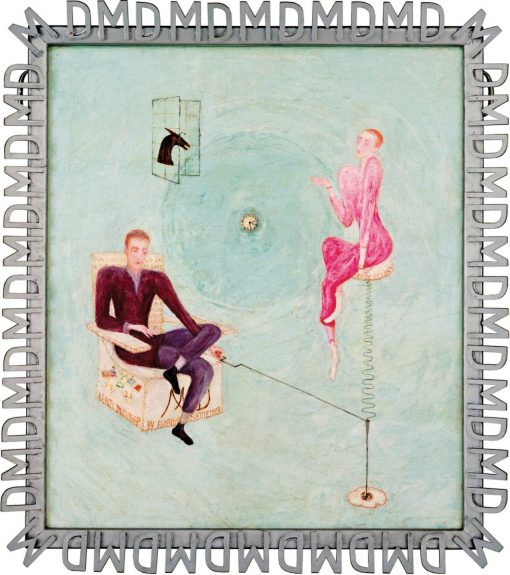
(Left) Man Ray, Rrose Sélavy (Marcel Duchamp), 1923. J. Paul Getty Museum, Los Angeles. https://www.artsy.net/partner/j-paul-getty-museum. (Right) Florine Stettheimer, Portrait of Marcel Duchamp and Rrose Sélavy, 1923, Museum of Modern Art, New York, https://www.moma.org/.
Readymades
This is where the urinal shows up. But by the time you arrive here, you understand it differently.
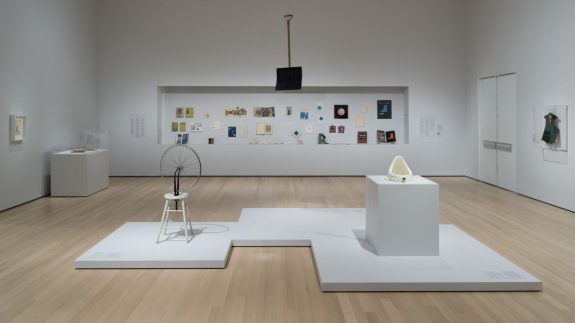
Installation view of the exhibition “Marcel Duchamp”. Museum of Modern Art, New York, https://www.moma.org/.
Duchamp wrote from New York to his sister Suzanne in Paris, first explaining the new term “readymades”: “Now, if you have been up to my place, you will have seen, in the studio, a bicycle wheel and a bottle rack…Listen to this: here, in N.Y., I have bought various objects in the same taste and I treat them as ‘readymades.’” As the name suggests, these already-made objects were acts that channeled Duchamp’s notion on art—that art did not have to be made, but only had to be chosen. An artist could select an ordinary manufactured object, place it in a new context, and through the act of choosing, make it mean something.
Most of his early readymades were only seen by friends who came to his studio, but Fountain (1917) was different. While being on the New York exhibition committee himself, he submitted the porcelain urinal to the exhibition under the fake name “R. Mutt,” specifically to test whether the organization’s open-admission policy was real. The work was rejected, and quietly removed from the floor before the show opened.
There is something about a readymade that is both distasteful and oddly attractive. You scoff at it, and yet your feet stop in front of it anyway to think, to process what you are looking at, and figuring out how and why you are reacting the way you are.
Duchamp may have intended all of those reactions. In the audio provided by MoMA, Duchamp explains that it was difficult “to find an object that I had no attraction [to] whatsoever from the aesthetic angle. Choosing the object you want to make should be completely impersonal, because if you introduce the idea of choice, it means that you introduce your taste. And taste is the great enemy of art, A-R-T.” The deliberate removal of taste was itself an artistic and radical decision because taste is what most people use to decide whether something is worth looking at in the first place. Contemporary American artist Liz Deschenes puts it plainly: “Taste is problematic for so many reasons, but probably the predominant one is: it creates hierarchies, that one thing is superior to another thing. It’s exclusive, and it’s purposely so.” By choosing objects that no one would call beautiful, Duchamp was refusing that hierarchy entirely.
So, Do You Like Duchamp’s Work?
This is just a glimpse of the vast exhibition covering the breadth of Duchamp’s life. The walk through these galleries can be short or long, depending on how comfortable you feel standing in front of something you can’t understand. The six decades that the exhibition covers are not easy to digest in one visit. By the end you have moved through painting, sculpture, alter egos, manufactured objects, miniature museums, and a hundred provocations that were misunderstood before they were understood, and you come out the other side with the feeling that you have spent time with someone genuinely strange, genuinely brilliant, and genuinely unbothered by your opinion of him.
His work is not for everyone. Some of it remains confusing, even absurd. Duchamp, characteristically, would consider that a reasonable response. He always believed it was the viewer who completed the work—that whatever happened in the space between an object and the person standing in front of it was where art actually lived. The choice you make, standing before a work of choice, is the work.
There might be something that caught your eye or unexpectedly matched your “taste.” For me, it was this ampoule containing 50 cc of Paris air.
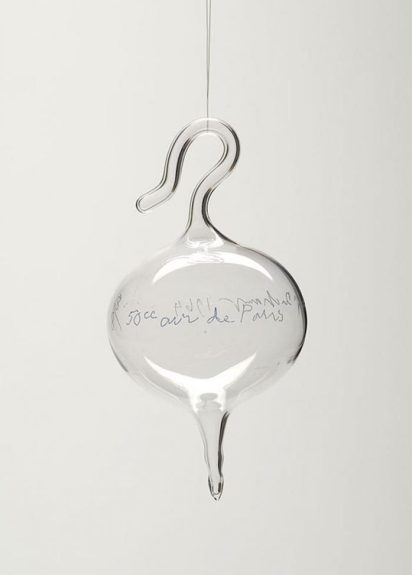
Marcel Duchamp. Air de Paris (50 cc of Paris Air). 1964 edition (after 1919 original). Museum of Modern Art, New York, https://www.moma.org/.
Duchamp’s work does not stand alone. It reaches into the viewer’s own experience and gives you the freedom to like it or not—which sounds simple, but is actually quite rare in a museum gallery, a space that is otherwise carefully structured to guide you toward a specific response. The bewilderment, the attraction, the conversation you end up having with whoever is standing next to you—your friend, your family, a complete stranger—questioning whether you even like what you are looking at, that freedom to decide, is what completes the experience.
“All in all, the creative act is not performed by the artist alone.” — Marcel Duchamp
Header via Author
 Loading ...