

 0 Comments
Please allow me to (re)introduce you to four of my favorite pieces from a recent trip to the museum.
Over Spring Break, I found myself in the Metropolitan Museum of Art (The MET) on a quest to discover some new pieces of art. Despite having been to this museum numerous times, it’s as if there are always new sections to explore and new artworks to learn about. Walking through the vast building, I took photos of some artworks I found particularly interesting that I hadn’t noticed before. Coming from vastly different cultures and historical backgrounds and composed of varying art mediums, here are four pieces you should check out the next time you are at the MET.
- The Daughters of Catulle Mendès, Huguette (1871–1964), Claudine (1876–1937), and Helyonne (1879–1955) by Auguste Renoir
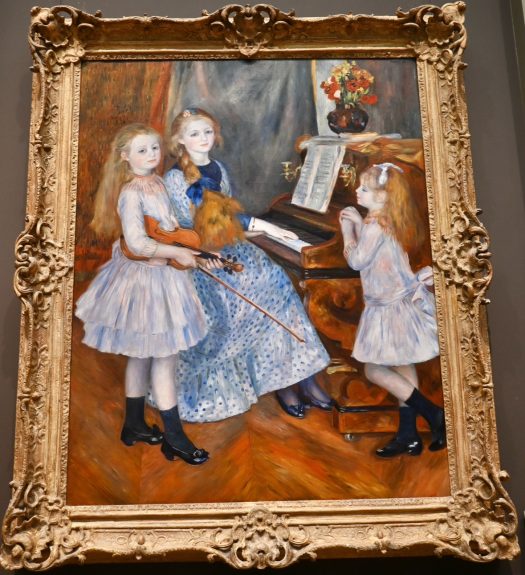
Located in Gallery 821 of the Annenberg Collection, the section of the MET that houses artworks by many renowned French artists of the nineteenth and early twentieth centuries, this painting by Renoir caught my eye due to the balance between warmer and cooler hues and the peaceful scene. The texture of the brushstrokes makes the painting even more visually appealing for me; the strokes are not overly smooth, yet are not jarringly rough, accentuating Renoir’s artistic style.
Additionally, the three girls seem quite at ease, with two of them looking calmly at the viewer, and the third leaning against the piano, as if excited to hear the musical instruments. This scene especially highlights the soothing qualities music can promote. - Plum (1886) by Jin Lan & Fan (1885-95) by L. Gérard
These two fans are on display in the Fanmania special exhibit in Gallery 690. Make sure you visit this gallery before May 12, which is when it closes. The upper fan was painted by a Chinese artist, while the lower was painted by a French artist, displaying the popularity of East Asian objects in France at the time this piece was made. I was especially intrigued by the thematic similarities and textural differences between the two fans. While both depict flowers commonly found in East Asia, the former looks more grainy, and the latter more silky due to the use of different paints and techniques. The right guard or outer stick of Gérard’s fan adds onto the floral theme, with an intricately carved flower pattern from wood.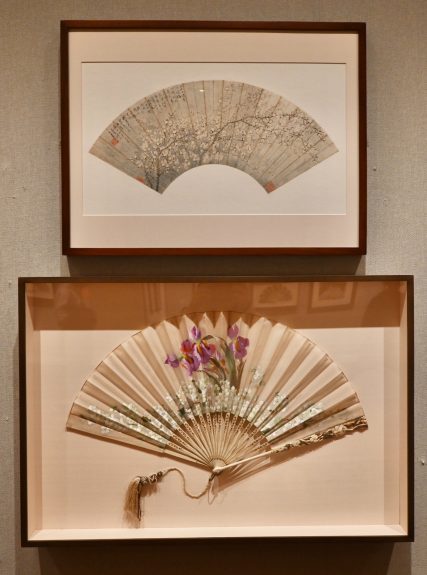
- A Vignette from the Book of the Dead (Facsimile ca. 1922, Original ca. 1279-1213 BCE)
Located in Gallery 132 of the Egyptian section of the MET, the colors of these three animals are particularly striking. It is important to note that this painting is a facsimile that was produced in 1922, while the original painting was created around 1279-1213 BCE. At first glance, the designs of the animals look rather simple. However, the patterns within each creature are intricate and composed of a diversity of shapes and patterns.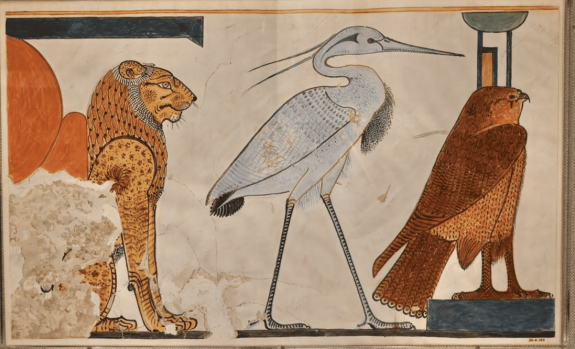
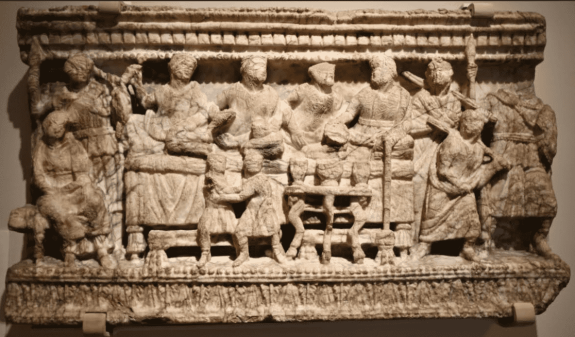
- Alabaster Cinerary Urn With Banqueting Scene
Displayed on the second floor of the Greek and Roman art section, this Etruscan cinerary urn doesn’t depict the usual Greek mythology, but rather a banquet in which an Etruscan king announces his successor. The carving of this scene emphasizes the artist’s close attention to every detail and the high level of skill required. Upon closer inspection, the men who are lined up in this carving have different physical attributes, giving each individual character and uniqueness.
A trip to the MET could be a great study break or social activity. These are only a few of the countless artworks that tell compelling stories and display distinct cultures and customs. Remember that your Columbia or Barnard student ID allows you to enter the MET for free!
Images via Author