

 0 Comments
On Saturday, April 25, Deputy Arts Editor Sydney Kaufman ventured into the Minor Latham Playhouse for some Tennessee Williams and 18th century psychological horror. Warning for depictions of violence, mental illness, and sexual harassment.
Last weekend, Barnard’s Theatre Department presented their Senior Theses in Directing: A Cavalier For Milady by Tennesee Williams as directed by Melañia Horowitz (CC ’26) and The Insanity of Mary Girard by Lanie Robertson as directed by Abigail Fixel (BC ’26). Entering the theatre presented the audience with an elaborate and luxurious sitting room, adorned with several patterned rugs and vintage paintings that tastefully elevated the worn-down walls. The set designs of Emerson Antunes Black (BC ’28) oriented the viewer immediately into the peculiar and hedonistic world of A Cavalier for Milady.
The first one-act tells the story of Nance (Reethi Shrikan, BC ’29), a grown woman in little girls’ clothes, who is left with the anxious babysitter Josie Flattery (Catherine Ryan, BC ’28) for the night by her mother (Olivia Beal, CC ’29) and her companion Mrs. Aid (Nonyi Usua, CC ’29). Mrs. Flattery arrives as the two discuss their evening plans with male escorts. Flattery is immediately put off by the situation, first from having to take a cab in from Queens to Park Avenue, and next from her ward for the night not being a child at all. Left alone with Nance, Flattery telephones her husband, describing Nance’s erratic and “indecent” behavior.
Flattery waits outside for her husband to pick her up and Nance begins talking to the nude male statue in the sitting room, who identifies himself as the apparition of the dancer Vaslav Nijinsky (Gia Ilardi, BC ’28). He dances for Nance and she makes several romantic advances towards him, which he rebuffs. He explains apparitions cannot touch or be touched by others or else they’ll disappear. After many attempts from Nance that would more than certainly cross the modern line of sexual harassment, the apparition allows moments of contact to pass between the two, but it is understood that Nance doesn’t physically feel them. “Vaslav” has an innate distaste for romance, perceiving it as both detrimental to his art and a reminder of his past experiences of being used by others.
Nance’s mother returns with Mrs. Aid, allowing Mrs. Flattery to leave in a huff. Mrs. Aid describes their night’s escapade in detail, rife with erotic exploits and theft from their escorts. Nance’s mother makes her own somewhat unnerving contributions. Nance begs to be left alone with her apparition, who once again rejects her advances. When she continues anyway, he leaves her, causing Nance to rush towards and collide with the statue, injuring her forehead. Nance’s mother and Mrs. Aid find that Nance’s attempts at expressing her sexuality are too inappropriate and have become unmanageable, deciding to have her committed to an asylum in the morning. They leave to plan for the following day, allowing Nance the opportunity to procure the card of an escort service, “Cavaliers for Milady,” from her mother’s purse. She calls, promising to pay extra for a man resembling Nijinsky.
Tennessee Williams’ real-life sister Rose, who underwent a lobotomy for schizophrenia, is noted as a parallel for Nance in Horowitz’s director’s note. This experience permeates throughout Williams’ characterization of Nance; though she shows a blatant and alarming disregard towards her apparition’s consent (or lack thereof), amidst the backdrop of the sexual details uncomfortably imposed upon her by her mother and Mrs. Aid, the audience begins to understand the influence of their behavior on Nance’s unspecified condition. The two women dissect and celebrate their own promiscuity while regarding Nance’s as a shameful malady. Is it fair to consider her mad for attempting to replicate the environment to which she is exposed?
Horowitz’s direction perfectly exemplifies the dynamics within the text. As Mrs. Aid forces her prurient recollections upon Nance, she also physically forces herself upon her (and, by extension, “Vaslav”) by uncomfortably crowding the child-sized sofa. When Nance later voices her displeasure at never being invited along with her mother and Mrs. Aid, the direction of the previous interaction makes it apparent Nance is so desperate for connection, she would accept it in a form that seems to cause her patent discomfort. Nance is solidified here as the victim of a cycle of behavior rather than an intentional perpetuator.
Though the hallucinations of “Vaslav” pale in comparison to those of Nance, Horowitz’s use of the space alludes to his delusions of divinity through a compelling hierarchy of scale. When he discusses seeing himself as “spiritual food,” akin to the wine and wafers served at church services to symbolize the body of Jesus, he is blocked close to the stage lights, casting a dramatic shadow that dwarfs Nance’s. Through the costume designs of Lexi Santos (GS ’27), the cold and monochromatic “Vaslav” is given excellent contrast to the vibrant, satin Nance.
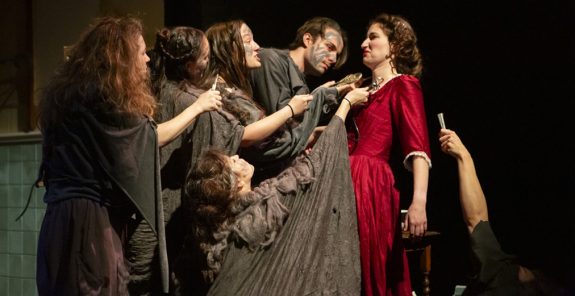
Next was The Insanity of Mary Girard, which follows Mary Girard (Ari Estrin, BC ’27), the married name of the historical Mary Lum, as she realizes she has been knowingly committed to an asylum under false pretenses by her abusive and unfaithful husband Stephen Girard. She processes this through an ensemble of six fantasized figures (Ryan Ingram, CC ’29, Mason Deas, BC ’28, Ava Kreutziger, CC ’28, Cooper Antczak, CC ’28, Samantha Grooms, BC ’29, and Sebastian Bader, CC ’26), furies whose lines cut each other off and personas morph into masked forms of the people in Mary’s life to illustrate her circumstances.
In the asylum, Mary is confined to a “tranquilizing chair” for long stretches of time. She recalls confrontations with her mother and her husband’s mistress, both of whom blame Mary for her husband’s behavior. When she later gives birth to a daughter, fathered by a man other than her husband, Mr. Girard claims no responsibility for the child and the doctor has a nurse care for her. The furies taunt Mary for her daughter’s tragically short life and the fact that Mary herself will never live to see the outside of the asylum’s walls again. Mary, beginning the play in a sound state of mind, ultimately gives into insanity, as it is the only rational response to her situation.
Fixel portrays Mary as a figure pushed to the edge by her experiences, framing her descent into madness as a reclamatory act. The material is already intense and nonlinear, heightened by the exaggerated line deliveries and extreme actions of the other characters. The furies undergo rapid changes between effective costumes designed by Vera Pankevich (CC ’27) as they shift between commentary on and depiction of the constant, unbearable torment represented under Fixel’s direction. The violent displays Mary endures include the sights of the bundle representing her baby being rapidly evaporated into feathers and her husband toppling a bedframe at her. The uncanny masks worn by each “real” character further serve to deeply unsettle the audience. (This writer personally possesses an irrational fear of The Phantom of the Opera that was not improved by this production.)
A Cavalier For Milady and The Insanity of Mary Girard speak to different interpretations of mental illness, yet in this Senior Thesis Festival, they converse with each other. Both Horowitz and Fixel expertly tackle the heavy themes of their productions, leaving their viewers to consider: are those deemed insane by society truly incurably ill, or are they the product of their inhospitable conditions?
Congratulations to the Theatre Department’s graduating seniors!
Header and image via Melañia Horowitz and Hunter Canning respectively.

 Loading ...